Range Rover has introduced an electrostatic speaker system in the SV Ultra, with Jaguar Land Rover saying it is the first production vehicle to use the technology. During a roughly 20-minute demonstration in the rear of the vehicle, the system delivered an unusually clear and spacious presentation that the reviewer described as the most impressive in-car audio experience he had encountered.
Conventional automotive speakers use a voice coil, a magnet and a diaphragm connected to a cone. An electrical signal moves the coil within a magnetic field, driving the cone back and forth to create sound waves. Most advances in premium car audio have retained that basic structure while improving materials, amplification, tuning and software. Planar magnetic designs remove the cone but still rely on magnets and coils.
The Range Rover system replaces those components with a 1-millimeter membrane suspended between two electrically charged metal plates. The membrane vibrates in response to an electrical signal, producing sound without cones, voice coils or magnets. A dismantled example shown during the demonstration was approximately palm-sized.
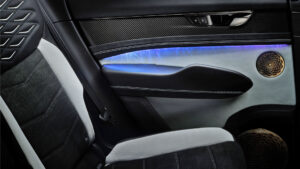
The SV Ultra uses 21 of these membranes across the cabin. Tilesh Karania, Jaguar Land Rover’s senior electrical innovation engineer, said the reduced moving mass allows the speakers to respond with high precision and without perceptible distortion. Land Rover also said the units respond 1,000 times faster than conventional speakers, use 90% less energy and contain 90% less mass. The design also avoids magnets and rare-earth materials.
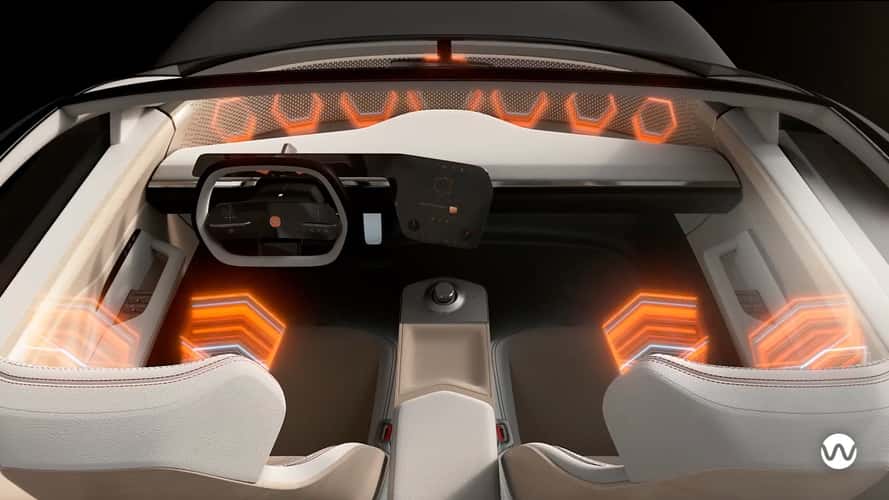
Because the electrostatic membranes do not handle every part of the system alone, the installation includes five additional bass speakers. It also uses what Land Rover calls “Body and Soul” seats and a “Haptic Floor.” Transducers create a bass-like vibration through the floor, while four transducers are installed in each seat.
The seat vibration can be reduced or switched off. During the demonstration, the reviewer found the haptic effect less convincing than the speakers themselves and described it as unnecessary beside the clarity of the main system. The electrostatic units, by contrast, were praised for producing crisp sound without muddiness, compression or audible distortion.
The technology was developed by U.K.-based Warwick Acoustics. The company estimates that, in an electric vehicle with a 100-kilowatt-hour battery, the lower power demand and reduced mass of its system could preserve up to 20 miles of WLTP range. Land Rover did not state how much lighter its installation is than a conventional premium audio system.
The demonstration included Susanne Vega and DNA’s “Tom’s Diner” and “Hotel California.” Breathing before vocal lines was clearly audible, while individual guitars, bass, drums and percussion remained distinct without overpowering one another. The presentation was described as more like a recording studio than a typical speaker system.
The strongest impression came from the apparent scale of the sound. Rather than seeming to originate from doors, the dashboard or pillar-mounted tweeters, the music appeared to extend beyond the cabin while remaining cohesive. The source does not provide pricing, wider availability details or a rollout plan beyond the Range Rover SV Ultra demonstration.