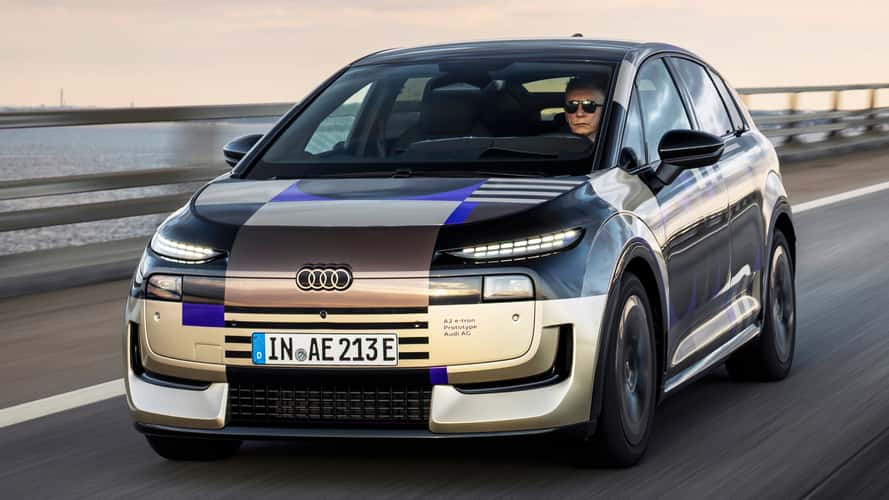
Audi says its upcoming A2 e-tron will be the most efficient vehicle it has ever produced, with preliminary WLTP testing showing 4.85 miles per kilowatt-hour when fitted with an optional efficiency package. The compact four-door electric hatchback is also positioned as the brand’s lowest-priced EV, according to information that appeared on a now-deleted Audi Germany webpage.
The new model revives the efficiency-focused approach of the original Audi A2 from the 2000s, but applies it to an electric powertrain. Audi says the efficiency package reduces energy consumption by as much as 0.9 kWh per 100 kilometers, or 1.44 kWh per 100 miles, compared with the standard configuration. Preliminary consumption is listed at 12.8 kWh per 100 km, equivalent to 20.59 kWh per 100 miles.
With the package installed, the A2 e-tron has a drag coefficient of 0.24, which Audi describes as the lowest among its compact models. The aerodynamic measures include an active front air intake, air curtains, gap reducers and gap breathers. The intake remains closed during normal driving and at higher speeds to reduce drag, but opens during charging, rapid acceleration or very hot conditions to help protect the battery and power electronics.
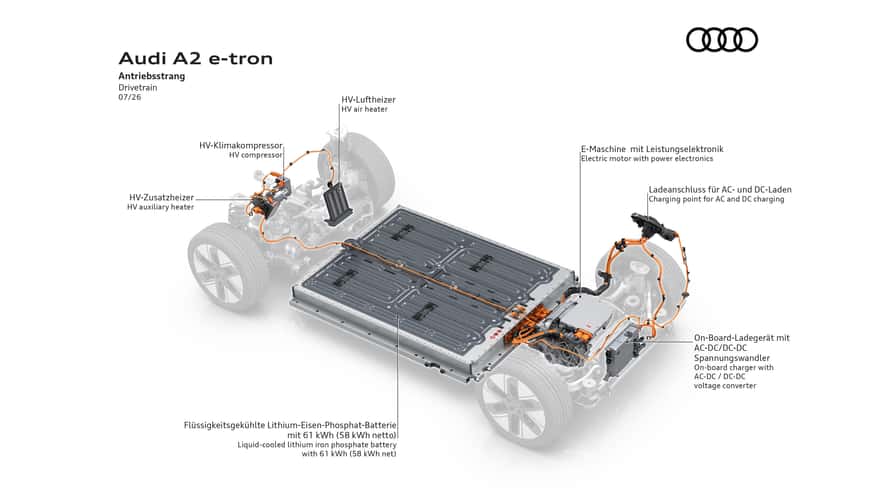
One confirmed battery option is a 58 kWh usable, 61 kWh gross lithium-iron-phosphate pack. Audi uses a cell-to-pack layout in which the cells are installed directly into the battery cradle. By removing the need for separate modules, the design increases energy capacity without requiring additional battery volume.
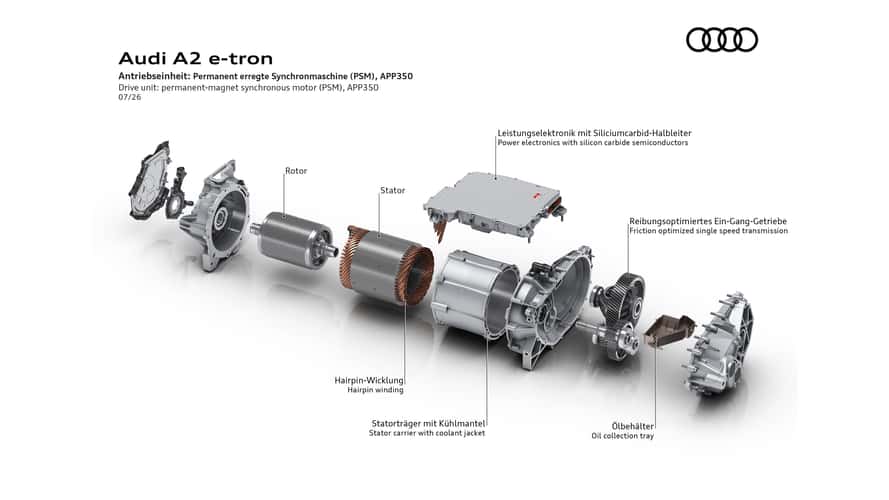
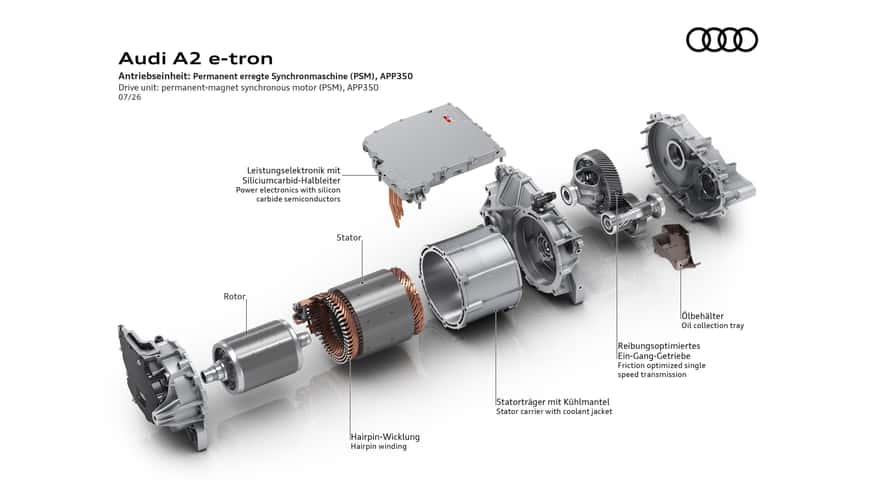
Audi also attributes the efficiency gains to changes beyond aerodynamics. The company cites revised battery thermal management, silicon carbide semiconductors in the power electronics, a new low-friction transmission oil and thinner laminations in the electric motor. A revised cooling strategy is also said to raise home charging efficiency to 89.6%.
The 58 kWh LFP battery will be paired with a 187 hp, or 140 kW, rear electric motor. A now-deleted page on Audi’s German website also listed three additional outputs: 167 hp, 228 hp and 321 hp, corresponding to 125 kW, 170 kW and 240 kW. The same page presented a maximum range figure of 403 miles, or 649 km, although the article did not treat the full technical configuration behind that figure as confirmed.
The A2 e-tron will support both vehicle-to-load and vehicle-to-home functions. Through a household socket in the trunk, V2L can supply up to 2.3 kW to tools, appliances or camping equipment. V2H uses the charging port to provide power to a home, provided the building has the necessary compatible equipment.
Audi plans to reveal the A2 e-tron fully in the fall. Pricing information shown on the deleted German webpage listed a starting price of €38,200 including VAT, which would make it Audi’s cheapest new electric vehicle. Until the formal unveiling, the confirmed focus remains on efficiency, compact-car aerodynamics, the LFP battery option and bidirectional energy functions.