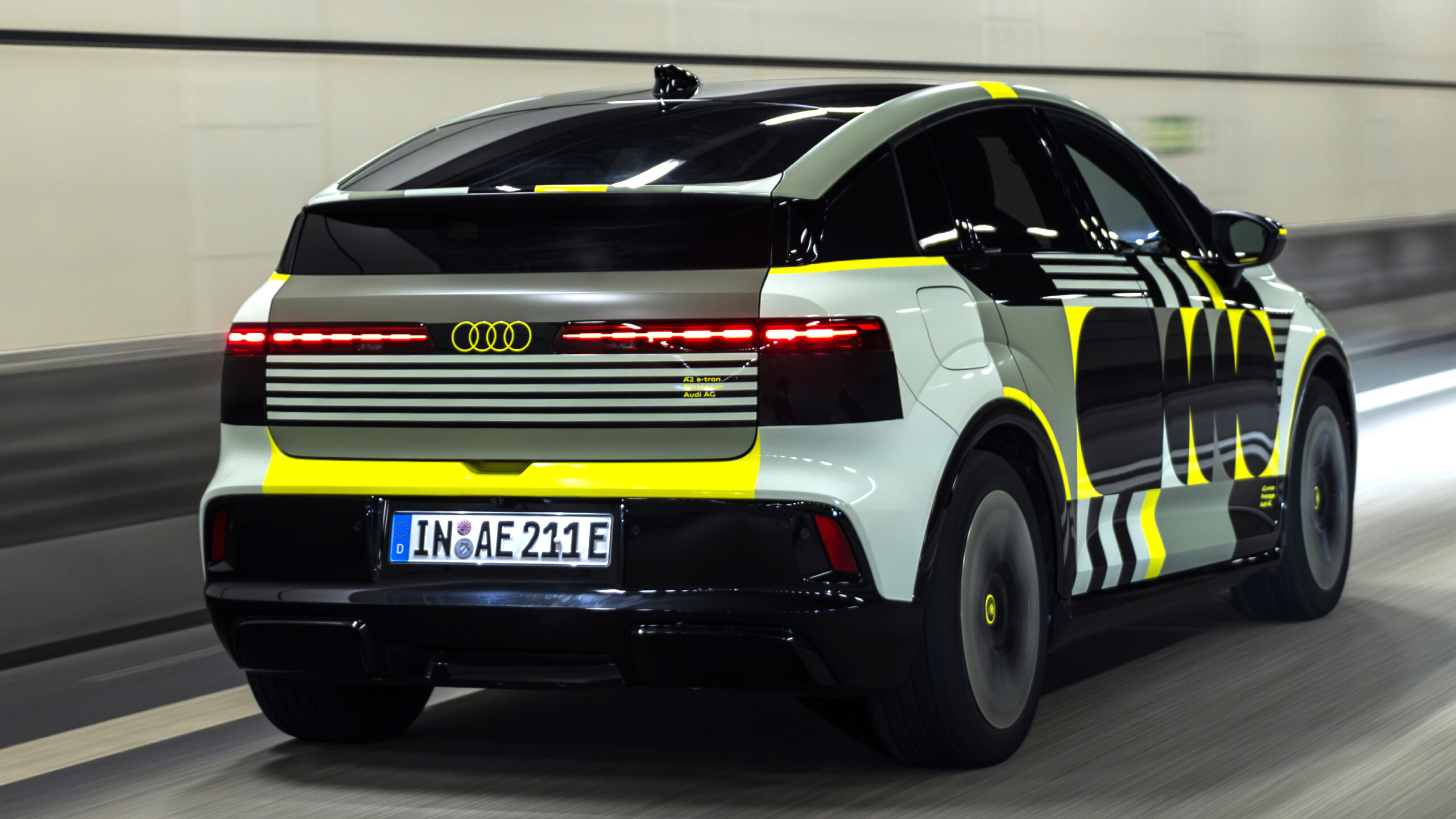
Audi is preparing to introduce the A2 e-tron this fall and describes the electric model as the most efficient vehicle it has produced. The initial technical information outlines three power outputs, a lithium iron phosphate battery option and loveral aerodynamic measures intended to reduce energy consumption.
One version will combine a 61 kWh lithium iron phosphate battery with a rear-mounted electric motor producing 188 hp, equivalent to 140 kW or 190 PS. Audi will also offer an optional efficiency package for this configuration. With the package fitted, the company says energy consumption will be 12.8 kWh per 100 km. Based on that figure, the source estimates a WLTP range of approximately 477 km, or 296 miles.
The powertrain uses Volkswagen’s latest APP350 drive unit. Its efficiency improvements include silicon carbide semiconductors, variable switching frequency, thinner laminations and an updated transmission designed to reduce friction losses. Audi also says the lithium iron phosphate battery uses a cell-to-pack construction, increasing energy density and allowing a comparatively large battery to fit within a compact package.
According to Audi, the battery does not require rare earth elements, ages more slowly than many alternatives and is considered particularly safe. The 188 hp version will support DC fast charging at up to 105 kW. Audi says charging from zero to 80 percent can take as little as 26 minutes, while an adapted cooling strategy enables wallbox charging efficiency of 89.6 percent.
Audi has confirmed two additional variants. A more powerful APP350 unit will produce 228 hp, or 170 kW and 231 PS, together with 258 lb-ft, or 350 Nm, of torque. The highest-output model will use a rear-mounted APP550 motor producing up to 322 hp, equivalent to 240 kW or 326 PS, and 402 lb-ft, or 545 Nm, of torque.
The information released so far indicates that the A2 e-tron will be offered only with rear-wheel drive. The model uses a 400V electrical architecture and is based on the MEB+ platform. Audi has also confirmed Vehicle-to-Load and Vehicle-to-Home bidirectional charging functions, allowing the battery to supply electricity beyond normal vehicle operation.
Audi says the vehicle’s exterior was developed with efficiency as a central objective. The aerodynamic package includes wheel deflectors, underbody paneling, a diffuser, aerodynamic wheels, air curtains and a splitter. An active air intake remains closed during most driving conditions to reduce drag, opening during charging, rapid acceleration and high temperatures when additional cooling is required.
These measures give the A2 e-tron a stated drag coefficient of 0.24. Audi says the aerodynamic design can lower energy consumption by as much as 0.9 kWh per 100 km. Further specifications have not yet been announced, with the initial release concentrating on the model’s powertrain choices, charging characteristics and efficiency-focused engineering before its planned introduction this fall.