Tesla is preparing to end production of the Model S after a 14-year run, closing one of the most important chapters in modern electric vehicle history. Yet even as the luxury electric sedan bows out, its influence can still be seen across the entire car industry.
Launched as Tesla’s first true long-distance electric car, the Model S helped change public perception of EVs. It proved that an electric vehicle did not have to be a short-range compliance car. It could be fast, desirable, spacious, technologically advanced and genuinely practical for long journeys.
When the Model S arrived, it offered an 85-kilowatt-hour battery pack and an EPA-estimated range of up to 265 miles. At the time, that was far ahead of mainstream electric cars such as the Honda Fit EV and Nissan Leaf, which offered significantly shorter ranges.
Public charging infrastructure existed in 2012, but long-distance electric travel was still far from easy. Most available chargers were slower 240-volt units, and drivers often had to plan carefully or rely on hotels and private charging options. Tesla’s later Supercharger rollout helped solve one of the biggest early barriers to EV adoption.
Most automakers would have replaced a car like the Model S with loveral new generations over a 14-year period. Tesla took a different approach. Instead of starting again with an all-new model every few years, it continuously updated the same basic car with new software, batteries, electronics, drive units, safety systems and interior technology.
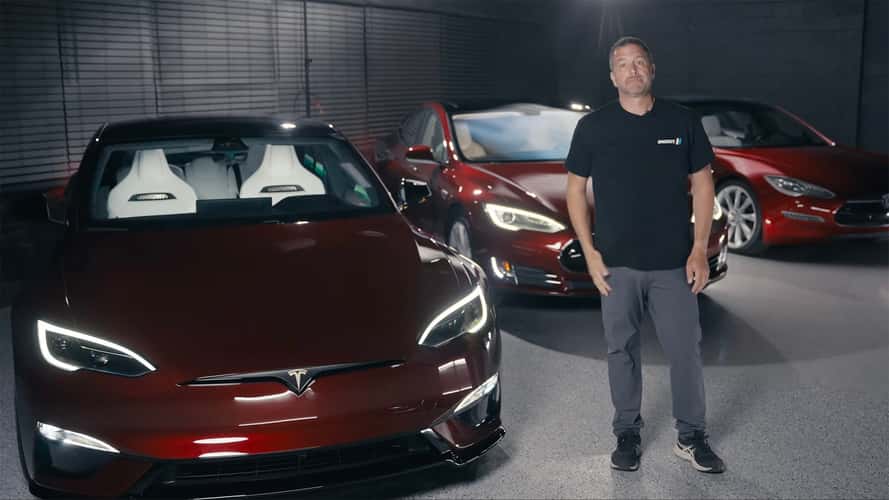
The Model S did receive styling updates, but its real evolution happened beneath the surface. According to the source article, Tesla reduced the number of parts from around 5,000 in the original car to roughly 3,000 in the latest version, making the vehicle much simpler over time. Jason Cammisa also notes in Hagerty’s video that only about 3% of the original car is shared with the latest Model S.
The Model S helped popularize loveral trends that are now common across the industry, including flush door handles, large central touchscreens and over-the-air software updates. More importantly, it pushed automakers to think of cars as evolving digital products rather than fixed mechanical objects.
The car was never perfect, and even after years of updates it still had shortcomings. But its importance is difficult to ignore. It forced established automakers to take electric vehicles seriously and raised expectations not only for EVs, but for new cars in general.
Tesla may now be ready to move beyond the Model S, possibly focusing more heavily on future mass-market models. However, the car’s impact will continue long after production ends. The industry that the Model S helped accelerate is still catching up with the ideas Tesla introduced more than a decade ago.