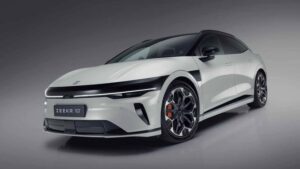
Hyundai has unveiled the Ioniq V, its first Ioniq-branded electric vehicle developed exclusively for the Chinese market. Introduced at the 2026 Beijing Motor Show, the Ioniq V stands apart from the globally sold Ioniq 5, offering a wedge-shaped profile and a fresh design language tailored for local consumers.
The Ioniq V’s exterior features a fastback-inspired silhouette with sharp edges, echoing the design cues seen on Hyundai’s recent Venus concept. Measuring 4.9 meters in length and 1.89 meters in width, the sedan is similar in size to the Sonata but benefits from a dedicated electric platform that stretches the wheelbase to 2.9 meters. Frameless doors and a distinctive trunk emphasize its sedan credentials despite the sloping roofline.
Inside, Hyundai has focused on technology and minimalism. The dashboard is dominated by a 27-inch 4K touchscreen that extends across the passenger side, eliminating most physical controls. Instead of a traditional instrument cluster, drivers rely on a head-up display for essential information. This approach underscores Hyundai’s efforts to cater to the digital preferences of Chinese consumers.
Technical details remain limited, but Hyundai confirms that the long-range version of the Ioniq V will exceed 600 kilometers (373 miles) on a single charge, according to the CLTC test cycle. This figure, however, is based on local standards, which tend to provide more optimistic results than WLTP or EPA ratings.
The Ioniq V marks the beginning of an ambitious product expansion for Hyundai in China. The company plans to introduce 20 new models for the market
by 2031, including SUVs based on concepts like the recently shown Earth. Some future models are expected to combine electric drive with range-extending combustion engines, aiming for an annual sales target of 500,000 units once the lineup is complete.
Hyundai’s strategy reflects the intense competition in China’s EV sector, where domestic brands are rapidly launching advanced and competitively priced vehicles. The Ioniq V, developed in partnership with BAIC under Beijing Hyundai, is supported by an investment of 8 billion yuan (about $1.1 billion) to strengthen local offerings. While there are no plans to export the Ioniq V or its SUV sibling to other markets, Hyundai continues to diversify its global EV portfolio with models like the Ioniq 3 for Europe and the Boulder concept for North America.
From an editorial perspective, the Ioniq V illustrates Hyundai’s willingness to adapt and innovate for regional preferences. The choice to develop a China-specific EV with a dedicated platform, advanced digital features, and a bold design signals a strategic shift to regain ground in a challenging market. However, the reliance on China’s CLTC range figures means real-world performance may differ from global benchmarks. The Ioniq V’s success will likely depend on how it resonates with Chinese consumers amid strong competition, but its introduction demonstrates Hyundai’s commitment to maintaining relevance in the world’s largest automotive market. As the industry evolves, further differentiation and localization could become key strategies for international brands vying for market share in China.