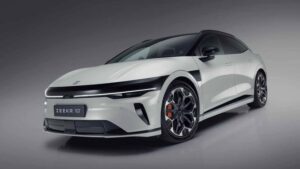
Hyundai has officially introduced the Ioniq 3, a new entry-level electric model positioned below the Ioniq 5 in its European line-up. Built on the same platform as the Kia EV3 and EV4, the Ioniq 3 targets urban drivers seeking practicality, efficiency and a distinct design in the compact EV segment.
The Ioniq 3 adopts a hatchback silhouette with crossover influences, sharing proportions close to the Hyundai Bayon. Its length varies between 4,155 and 4,170 mm, while a wheelbase of 2,680 mm matches that of the Elantra, providing a spacious cabin for its class. The production model adopts a conventional five-door format, forgoing the more experimental elements of the earlier concept. Up front, split LED lighting and four illuminated dots referencing the Hyundai ‘H’ in Morse code are distinctive features. At the rear, a split window with a robust horizontal bar housing the rear wing hints at unconventional design, while black cladding and bold surfaces add visual weight. The N Line variant introduces sportier bumpers, a rear spoiler, and model-specific 19-inch alloy wheels, contrasting with the standard 16-inch wheels.
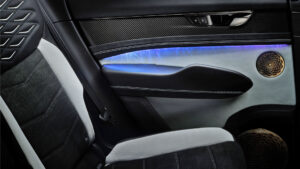
Inside, the Ioniq 3 offers a 14.6-inch free-standing touchscreen on upper trims, while base versions receive a 12.9-inch unit paired with a compact digital instrument cluster. Both use Hyundai’s new Google-based Pleos infotainment system, featuring physical switches for essential functions and tactile controls on the N-branded steering wheel. The gear lever is integrated into the right stalk, freeing space in the slim centre tunnel for storage and cup holders. Key comfort features include heated and ventilated Relaxation Seats, a panoramic sunroof, rear climate vents, a Bose Premium audio system, and the Hyundai SmartSense ADAS suite. The boot provides 441 litres of capacity, aided by a double floor and additional underfloor storage reminiscent of the Ford Puma’s Megabox.
The electric hatchback rides on a 400-volt version of Hyundai’s E-GMP architecture. At launch, two front-wheel-drive configurations will be available. The Standard Range version uses a 144 bg electric motor with a 42.2 kWh battery, offering a WLTP range of 344 km. The Long Range variant features a 133 bg motor and a 61 kWh battery, extending range to 496 km on a full charge. Both options deliver 250 Nm of torque. Hyundai’s N division is reportedly considering a high-performance Ioniq 3 N, potentially utilising a dual-motor setup with power outputs similar to the Kia EV3 GT-Line’s 288 bg, along with chassis and electronics enhancements from the Ioniq 5 N and Ioniq 6 N.
The Ioniq 3 is scheduled to enter the European market later this year, with production based in Turkey. This localisation supports competitive pricing and explains its absence from the US market, where tariffs would raise costs considerably. The model enters a rapidly expanding segment, competing with electric subcompact SUVs such as the Kia EV3, Mini Aceman, Renault 4 E-Tech, Ford Puma Gen-E, Jeep Avenger, Alfa Romeo Junior, Volvo EX30, and Opel Mokka Electric. On the hatchback front, rivals include the Renault 5 E-Tech, BYD Dolphin, MG4 EV, and the forthcoming VW ID. Polo.
Hyundai’s decision to introduce the Ioniq 3 at the lower end of its electric line-up is a calculated response to growing demand for practical and affordable EVs in Europe. The model strikes a balance between distinctive styling, advanced technology, and everyday usability. Its competitive range and adaptable interior should appeal to urban drivers prioritising efficiency and comfort. With production centred in Turkey, Hyundai aims for a cost advantage in a market crowded with established and new electric contenders. As the Ioniq 3 prepares to join the European market, its reception will likely influence future developments in Hyundai’s compact EV strategy and may set new standards for entry-level electric mobility in the region.