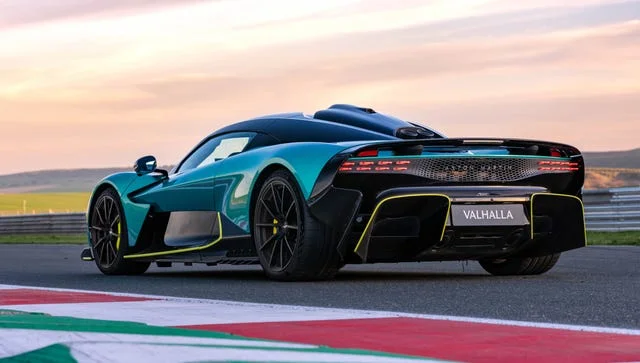
The Aston Martin Valhalla’s advanced hybrid system once allowed it to reach an astonishing 87 mph in reverse during development, forcing engineers to impose strict electronic limits for safety and control.
The Valhalla features a sophisticated powertrain that combines a combustion engine with three electric motors. One motor works alongside the engine, while two independent electric motors power the front wheels, enabling all-wheel drive functionality.
Unlike traditional setups, these front-mounted electric motors are solely responsible for reverse motion. This eliminates the need for a conventional reverse gear in the eight-speed dual-clutch transmission, but it also introduced an unexpected challenge.
During testing, engineers discovered that the two front electric motors could propel the Valhalla to approximately 87 mph in reverse—the same speed it can achieve in electric-only mode moving forward. While impressive, such performance posed serious safety concerns.
Although the idea of a supercar racing backwards at high speed sounds cinematic, it was deemed impractical for real-world use. As a result, Aston Martin electronically limited the reverse speed to around 18 mph for production models.
This phenomenon isn’t unique to the Valhalla. Electric and hybrid vehicles can theoretically achieve high reverse speeds due to the nature of electric motors, which can spin in either direction without mechanical constraints.
Some manufacturers have even explored this capability. For example, Rimac set a Guinness World Record in 2023 with the Nevera, reaching 171 mph in reverse. However, most automakers choose to impose electronic limits to ensure safety and drivability.
The Valhalla’s reverse speed limitation highlights the balance engineers must strike between performance and usability. While cutting-edge technology can unlock extreme capabilities, real-world safety considerations ultimately define what reaches production.