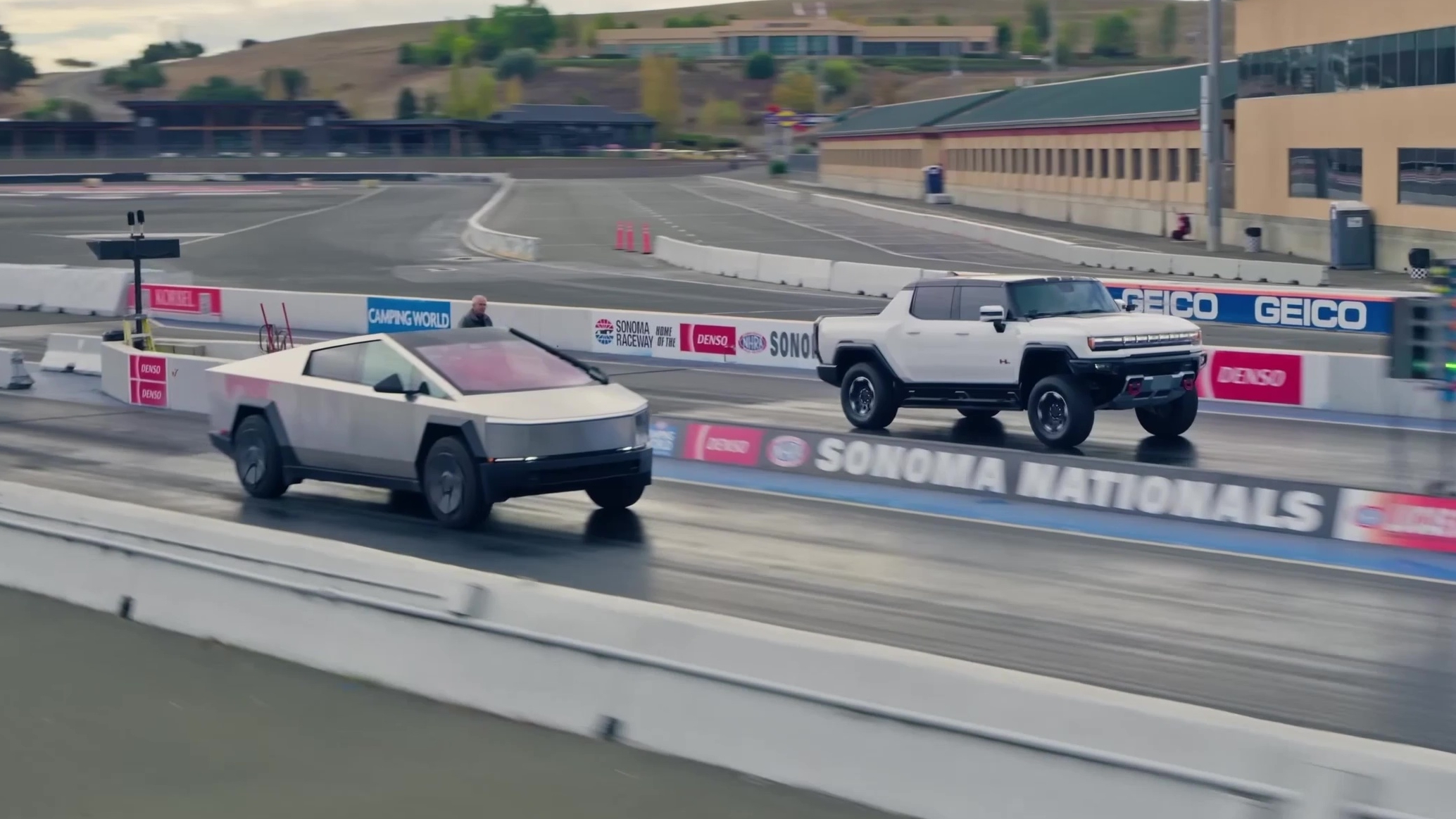
A recent drag race at an American strip pitted the Tesla Cybertruck against a 1970 Chevrolet Chevelle Malibu, delivering a surprising outcome. While expectations favored the electric truck’s rapid acceleration, the classic muscle car managed to cross the finish line first, despite the Tesla posting a higher trap speed and a quicker elapsed time.
The Chevelle, extensively modified with wide rear tires and aftermarket wheels, lined up against the Cybertruck on the quarter-mile. It’s believed to be powered by a big-block V8, possibly delivering between 500 and 600 horsepower, typical of modern builds based on the era’s 454 cubic inch engines. The Cybertruck, likely the tri-motor Cyberbeast variant with 845 hp, was expected to launch aggressively, but the race did not unfold as predicted.
At the light, the Chevelle driver reacted quickly, gaining an early lead as the rear tires dug in. The Cybertruck, by contrast, had a slow reaction off the line, giving the classic Chevy a visible advantage through the first half of the run. However, as the Tesla’s motors reached full power, it began closing the gap, accelerating rapidly down the track.
Despite the late surge, the Cybertruck fell just short. The Chevelle crossed the finish line first, clocking an 11.69-second quarter mile at 114.9 mph (185 km/h). The Cybertruck completed the run in 11.39 seconds at 118.6 mph (191 km/h), showcasing its superior speed and acceleration, but ultimately losing due to the slowe
r start.
The 1970 Chevrolet Chevelle Malibu in this race was far from factory stock. Sporting modifications aimed at drag racing, it likely featured a high-displacement V8 with significant power upgrades. The Tesla Cybertruck, in its top-spec Cyberbeast configuration, brings all-wheel drive and immediate electric torque, making it a strong competitor in straight-line performance.
This contest highlights the importance of reaction time in drag racing, where the first car across the line claims victory, regardless of elapsed time or top speed. The Cybertruck’s superior numbers on paper were not enough to overcome the Chevelle’s quicker start.
This matchup serves as a reminder of how classic muscle cars continue to hold their own against modern electric vehicles, at least in real-world scenarios where driver input remains critical. The Chevelle’s win is a testament to the enduring appeal and capability of traditional American V8 power, even when facing technologically advanced rivals like the Cybertruck. While the Tesla demonstrated impressive speed and acceleration, a better reaction time could have easily swung the result. For enthusiasts, this race underscores that technology alone does not guarantee victory—skill and timing still play decisive roles. Looking ahead, rematches between EVs and classic muscle cars will likely continue to captivate fans and fuel debates about the future of performance vehicles.