The Skoda Epiq is shaping up to be one of Europe’s most practical small electric SUVs, combining compact dimensions with a generous trunk, clever storage solutions and up to 273 miles of WLTP range. Although it sits in the entry-level EV segment, Skoda has focused heavily on usability rather than simply chasing a low price.
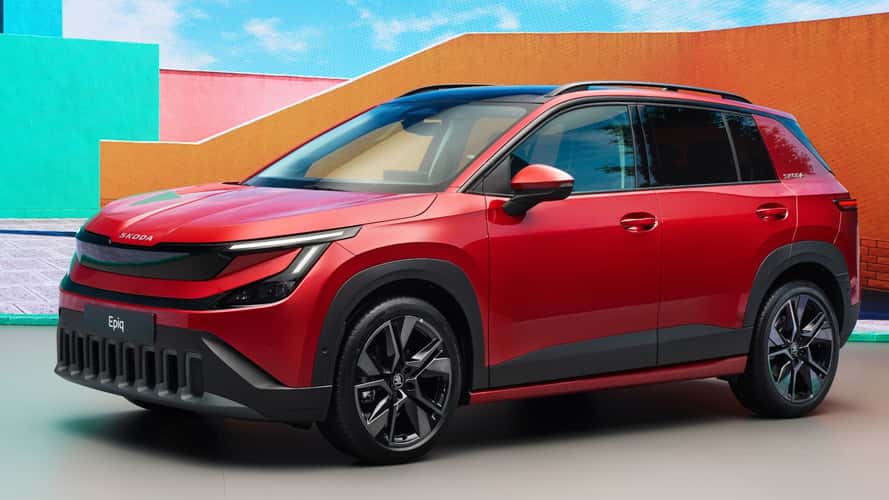
Skoda’s new Epiq is mechanically related to the Volkswagen ID. Polo and Cupra Raval, but its taller and boxier crossover body gives it a more practical character. The design follows the same visual direction as Skoda’s larger electric SUVs, including the Elroq and Enyaq, while also taking cues from the brand’s 7S concept.
Despite its compact footprint, the Epiq has been packaged to feel larger than its exterior dimensions suggest. It measures 164.2 inches, or 4,171 mm, in length, making it the same length as a Fiat 600e. At 62.2 inches, or 1,581 mm, tall, it has a more upright stance that helps support its SUV-like cabin and cargo layout.
One of the Epiq’s strongest points is cargo capacity. Skoda says the model offers 16.77 cubic feet, or 475 liters, of trunk space. That is supported by a 0.9-cu-ft, or 25-liter, front trunk and another 1 cu-ft, or 28 liters, of storage split between the glovebox and the central armrest compartment.
This focus on storage gives the Epiq an advantage for buyers who want a compact EV without giving up everyday usability. The layout appears designed for European city driving, but with enough luggage capacity for family use and longer trips.
The Skoda Epiq uses the same front-wheel-drive version of the MEB architecture as the Volkswagen ID. Polo and Cupra Raval. The platform supports single-motor front-wheel-drive versions only, meaning all-wheel drive is not part of the lineup.
The entry-level model uses a 38.5-kWh lithium iron phosphate battery with 37.5 kWh of usable capacity. A larger 55-kWh nickel manganese cobalt battery, with 51.5 kWh usable, is also available. Skoda expects the smaller battery to deliver 192 miles, or 310 km, on the WLTP cycle, while the longest-range version should reach 273 miles, or 440 km, on a charge.
Charging performance varies depending on the version. The base Epiq 35 has a peak DC fast-charging rate of 50 kW and can charge from 10 to 80 percent in 33 minutes. The Epiq 40 raises peak charging to 90 kW, reducing the same charging window to 25 minutes.
The range-topping Epiq 55 supports up to 105 kW DC charging and completes a 10-to-80 percent charge in 24 minutes. These figures place the Epiq in line with the expectations for a small European electric crossover rather than a high-performance charging flagship.
The base Epiq 35 produces 114 horsepower and accelerates from 0 to 62 mph, or 100 km/h, in 11 seconds. The Epiq 40 increases output to 133 hp and improves acceleration by more than a second.
The most powerful Epiq 55 delivers 208 hp and cuts the 0-62 mph time to 7.1 seconds. That makes it the most appealing version for buyers who want stronger performance without moving into a larger and more expensive EV.
Standard equipment includes a 13-inch infotainment screen running an Android-based operating system, 17-inch wheels and a center airbag between the front seats. Wheel sizes can rise to 20 inches depending on specification.
Skoda will also offer Travel Assist 3.0 as an option. According to the source, the system can respond to traffic lights and bring the vehicle to a stop when required. Automatic parking is also available.
The Skoda Epiq can be ordered in Europe from €32,100, though that figure is likely linked to a better-equipped First Edition model. The base version, with the smallest battery and lowest power output, is expected to start closer to €26,000.
With its compact size, useful range and strong cargo capacity, the Skoda Epiq could become one of the more important small electric SUVs in Europe. It is not designed to be the fastest or most advanced EV in its class, but its practicality-first approach may make it highly relevant for everyday buyers.