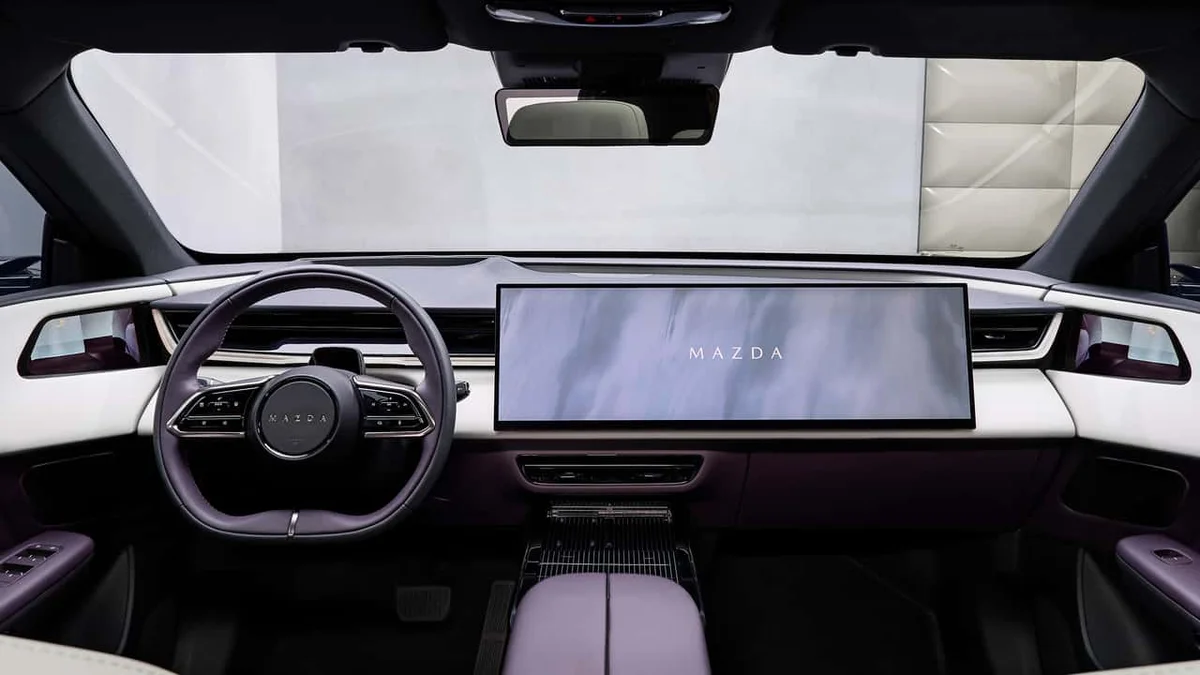
Mazda is embracing larger infotainment screens in its latest electric vehicles, arguing that bigger displays enhance clarity without compromising driver focus. The brand’s new China-built EVs mark a major shift from its traditional minimalist interiors.
For years, Mazda resisted the industry trend of oversized infotainment displays, prioritizing physical controls and driver-focused layouts. However, its newest electric models, including the CX-6e and 6e, signal a clear change in direction. These vehicles feature expansive screens that dominate the dashboard, reflecting evolving consumer expectations and technological advancements.
Jo Stenuit, Mazda’s European Design Director, defends the move, emphasizing that larger displays are not about showing more information, but presenting it more clearly. In the CX-6e, the massive 26-inch screen even extends toward the passenger, encouraging a more shared in-car experience.
According to Stenuit, improved visualization helps occupants better understand vehicle data without increasing distraction, aligning with modern digital interface trends.
Despite the larger screens, Mazda insists that driver focus remains the priority. The brand is increasingly relying on head-up display (HUD) technology, projecting key driving information directly onto the windshield. This approach reduces the need for traditional instrument clusters and allows drivers to keep their eyes on the road.
Mazda believes that a well-implemented HUD can replace conventional gauges entirely, improving safety and usability.
Not all Mazda EVs follow the same formula. The 6e liftback, developed with Chinese partner Changan, uses a more balanced setup with a 10.2-inch digital instrument cluster and a 14.6-inch central touchscreen. Meanwhile, even combustion models like the CX-5 are adopting larger displays, now offering a 15.6-inch infotainment screen.
Mazda maintains that the transition toward touchscreen-heavy interiors is driven by customer feedback rather than cost-cutting. The company has developed a new human-machine interface (HMI) aimed at simplifying interaction while reducing the need for drivers to take their hands off the wheel.
This shift includes moving away from rotary controllers toward touch-based systems, which Mazda claims are more intuitive for modern users.
The brand’s dramatic pivot reflects broader changes in both technology and consumer expectations. While some enthusiasts may miss the tactile controls of older models, Mazda sees large screens and digital interfaces as the future of automotive interiors. However, many hope that driver-focused icons like the Miata will retain a more analog, minimalist approach.